

Last Updated: November 7, 2026
Quick Summary
Nature themed coloring books for mindfulness and focus give a restless brain one small, concrete task to hold onto, asking for attention rather than decisions. Choose repeating patterns like ferns and vines to settle a racing mind, and start with one small section for ten minutes.
- Name the feeling you want to leave with before you open the book.
- Limit your palette to two or three colors to reduce decisions.
- Set a ten-minute timer and stop even if the section is unfinished.
- Pick repeating patterns like ferns, vines, and ripples to build rhythm.
- Check that lines are clear, detail is not hairline, and pages print on one side.
Table of Contents
- Why Nature Themed Coloring Books Slow a Racing Mind
- How to Color Mindfully, One Page at a Time
- Mindful Coloring Exercises to Try This Week
- Choosing Nature Coloring Pages for Adults That Actually Work
- Frequently Asked Questions
Why Nature Themed Coloring Books Slow a Racing Mind
Nature themed coloring books for mindfulness and focus give a restless brain one small, concrete task to hold onto. The page asks for attention, not decisions. That shift is the whole point, and it is why we at LumaLayer Creations keep coming back to nature imagery in our own coloring work.
Coloring is not a proven cure for a racing mind, though. Researchers Mantzios and Giannou noted in a 2018 paper in Frontiers in Psychology that adult coloring had been linked to mindfulness, but whether it truly increases it had not been addressed. So treat coloring as a practice, not a promise.
What makes nature pages different is the material itself. Leaves, ferns, and shells have irregular edges. Your eye has to slow down to follow them.
- Leaves and vines: repeating curves that pull the eye into a rhythm
- Flowers: layered petals that ask for careful color choices
- Water and sky: soft gradients that reward a light hand
- Shells and stones: tight patterns that demand short, steady strokes
That gentle pull is what turns a page into a pause.
How to Color Mindfully, One Page at a Time
Most coloring advice stops at “slow down.” A repeatable method is more useful. The process below is built around one simple idea: pick one theme, let it shape every choice, and resist the urge to over-explain it.
Step 1: Name the feeling you want to leave with
Before you open the book, finish this sentence: “I want to feel ___ when I close this page.” Calm, curious, grounded, and playful are common answers. Write it down. A named feeling is easier to protect than a general wish to relax.
Step 2: Pick one small area, not the whole page
Choose a single leaf, petal, or shell. The rest of the page waits.
Step 3: Limit your palette to two or three colors
Fewer choices mean fewer decisions, and decisions pull a racing mind back into planning mode. Try one dominant color, one supporting shade, and one accent.
Step 4: Set a short timer
Ten minutes is enough to start. When the timer ends, stop even if the section is unfinished. The unfinished page is the practice, not a failure.
Step 5: Color slowly and let strokes overlap
Feel the pencil drag and the paper texture. If your mind wanders, return to the last stroke rather than scolding yourself.
Step 6: Review without judging
Look at what you made for thirty seconds. Name one thing you notice, pressure, color, rhythm, and leave it there. No grading.

Watch out: skipping straight to a full-page spread on day one can make the method harder to sustain. Starting with one section is a gentle way in.
The pencil you use matters more than people expect. Hard leads skip across fine detail, while softer ones blend. Our guide to the best colored pencils for detailed coloring books covers which leads suit tight line work.
Here is the six-step method at a glance, with the time and limits the article sets for each step.
| Step | What to do | Time or limit |
|---|---|---|
| 1 | Name the feeling you want to leave with | Write it down before opening the book |
| 2 | Pick one small area, not the whole page | One leaf, petal, or shell |
| 3 | Limit your palette | Two or three colors |
| 4 | Set a short timer | Ten minutes is enough to start |
| 5 | Color slowly and let strokes overlap | Return to the last stroke if the mind wanders |
| 6 | Review without judging | Look for thirty seconds, name one thing |
Mindful Coloring Exercises to Try This Week
Three short exercises cover most of what mindful coloring exercises are meant to do. Each takes under fifteen minutes and needs only a book and a pencil.
- The single leaf: color one leaf in one color, then a second leaf in a lighter shade. Notice the difference in pressure.
- The breathing page: color one small shape per slow breath. Stop when your breath settles.
Coloring for stress relief works best when you drop the goal of a finished page. The unfinished page is not a failure. It is the practice.
Choosing Nature Coloring Pages for Adults That Actually Work
A page that looks impressive online can be the wrong page for a restless mind. Match the page to your goal, the way a writer matches a theme to a reader’s age and emotional stage, instead of buying on aesthetics alone.
Match the page to your goal
- For settling a racing mind: choose repeating patterns, ferns, vines, ripples, where the eye can fall into rhythm.
- For gentle focus: choose layered flowers or shells with mid-range detail that rewards careful color choices.
- For a short session: choose pages with clear, separated sections so you can finish one area in ten minutes.
- For a longer unwind: choose full spreads with soft gradients in water and sky.
Match the page to your experience level
Beginners often find consistent line weight and medium detail easier to settle into. Experienced colorists can handle tighter patterns. If you cannot tell where one shape ends and the next begins at a glance, the page will frustrate rather than settle you.
Check the physical book before you commit
- Lines are clear and evenly weighted
- Detail is fine but not hairline
- Paper is thick enough for layered pencil
- Pages print on one side only
- The theme matches what you actually find calming
Watch out: buying a book because the cover art is striking is the most common mismatch. Flip to an interior page first and ask whether you would enjoy coloring that specific pattern for ten minutes.
A quick evaluation exercise
Before you buy, rank three candidate pages on two questions: Does the pattern repeat enough to create rhythm? Is the detail small enough to require attention but large enough to finish a section in one sitting? The page that scores well on both is usually the right one.
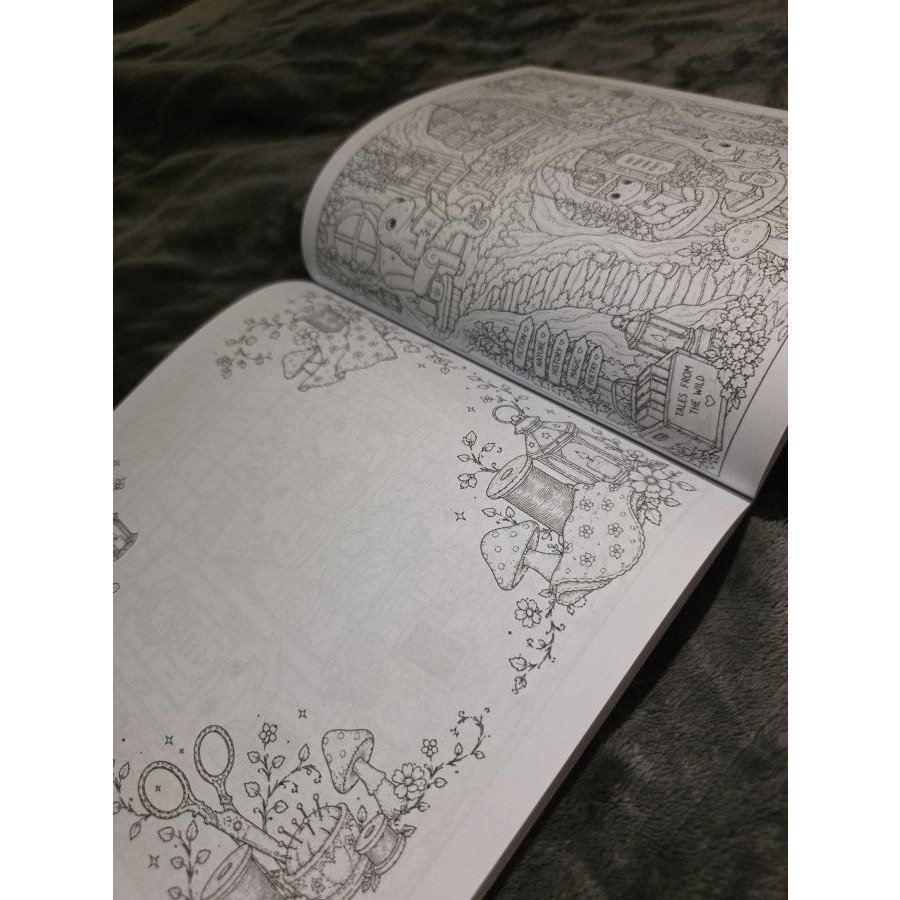
When you are ready to pick a book, browse our coloring books for adults to see the nature and cottagecore titles we publish. If reptiles and woodland scenes appeal to you, our cottagecore reptile coloring book guide walks through that niche in more detail. And if you would like to turn a finished page into something you can wear or display, our custom apparel printing service can put your artwork on a shirt, while our 3D printing service can bring small nature-inspired designs into your hands as tactile objects.
A racing mind rarely settles on command. It settles on a task that is small, quiet, and just interesting enough to hold. That is what a good nature page offers, and it is what we build into every LumaLayer Creations coloring book: original artwork, nature-forward themes, and pages designed for slow, focused coloring. Explore our shop and find a book that makes ten quiet minutes feel easy.
Frequently Asked Questions
How long should a mindful coloring session last?
A 15 to 30 minute session gives you enough time to feel the shift without turning it into a chore. Beginners often do better with 10 minutes daily than one long weekend session. Set a timer so you are not checking your phone, and stop when your attention starts drifting rather than pushing through. The goal is a calm, focused stretch, not a finished page.
What should you look for in nature themed coloring books?
Look at line weight, paper quality, and design variety. Thin, faint lines are hard to follow and strain your eyes, while bold outlines help you settle into a rhythm. Flip through to confirm the designs vary enough to hold your interest. A mix of detailed botanicals and simpler landscapes lets you match the page to your energy level.
Can coloring really help you relax and concentrate?
Coloring gives your hands a simple, repetitive task, which can make it easier to stop replaying the day in your head. That said, it is not a guaranteed fix. Research on adult coloring and mindfulness is still limited. Treat coloring as one calming habit among several, and notice for yourself whether it helps you focus.

0 Comments